From Pilot Purgatory to Agentic AI at Scale: Why Most AI Projects Die and How to Resurrect Them
Why do most AI projects fail to scale? Explore the barriers behind pilot purgatory and the agentic AI model needed to move from experimentation to production.
Sravanth Aluru


The AI Paradox: Pilots Everywhere, Transformation Nowhere
Walk into any enterprise boardroom today and you’ll see the same pattern: dozens of AI “proofs of concept,” each promising transformation, yet few ever reach production.
A recent MIT–Fortune study found that 95% of generative AI projects fail to deliver measurable P&L impact, while CIO Magazine reports that 88% of AI pilots never reach production.
Despite billions spent, most organizations remain trapped in pilot purgatory, a cycle of experiments that showcase potential but never create durable enterprise value.
The issue isn’t vision; it’s translation, the inability to move from AI in the lab to AI in the line of business.
Why Most AI Pilots Stall (and Die)
After years of working with Fortune 500s across retail, manufacturing, logistics, and telecom, five recurring fault lines emerge that doom AI initiatives.
The root issue? Most pilots are built in frictionless environments, detached from real users, messy data, and operational constraints.
Too often, enterprises apply a one-size-fits-all approach to AI, with generic models chasing generic use cases. Real transformation requires working backward from the exact industry problem and architecting solutions tailored to that context.


Misaligned Scope & Demo-itis
Too many pilots are built to impress, not to integrate. They aim to prove something, not to solve something. According to RAND’s research, many AI pilots suffer from “expectation misalignment,” having been designed in innovation labs far removed from real operational pain points.
This one-size-fits-all mindset, which prioritizes generalized solutions over industry-grounded architectures, compounds the problem. When the business problem is unclear, ROI vanishes and enthusiasm fades.
Fragmented Ownership
Pilots often start as isolated innovation projects without P&L accountability. When it’s time to scale, there’s no operational owner to carry them forward.
Data and Infrastructure Silos
Most AI models are trained on sandbox data. Faced with messy real-world systems, they collapse under integration complexity.
Legacy infrastructure, weak APIs, and brittle architectures often block scaling. CIO.com notes that “incomplete data pipelines and fragmented architectures” are among the top reasons AI pilots fail to operationalize.
ROI Ambiguity
Many pilots chase novelty, not outcomes. Even when a pilot performs technically, its business value is often diffuse, delivering fewer errors, faster processing, or better insights without a clear link to P&L impact.
Executives struggle to justify scaling when the financial case is unclear.
Governance Gaps
When pilots mature, governance often becomes the new bottleneck.
Most organizations try to fit AI into traditional IT governance models, but challenges such as model drift, bias, explainability, and security require new control frameworks.
Without governance built in from the start, scaling can introduce operational and reputational risk.
The Human Disconnect
AI is often introduced to people, not with them. Resistance from operators and middle managers, the true levers of scale, becomes a silent killer.
MIT’s report calls it a “learning gap, not a model gap.” Without internal skill maturity, scaling efforts often stall under the weight of technical debt.
The Path Out: Building an Agentic AI Foundation
The shift from pilots to production requires a new design paradigm, one rooted not in projects but in platforms, and not in experiments but in execution systems.
The way out starts with precision, not by scaling generic models, but by designing domain-aware systems that work backward from the problem statement and the realities of the industry.
We call this transition Agentic AI, a model in which autonomous, domain-aware agents drive business outcomes within governed, human-supervised frameworks.
At its core, Agentic AI demands four simultaneous transformations:
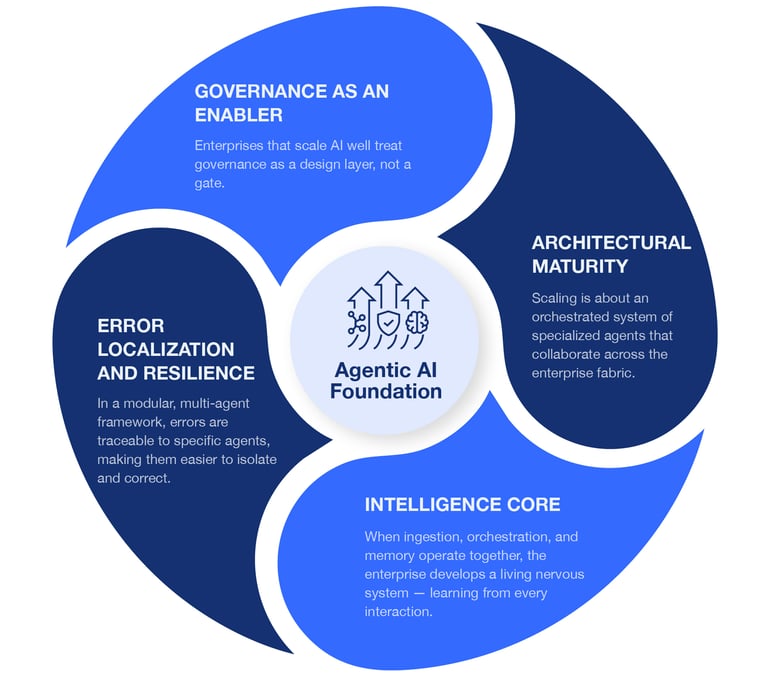
1. Architectural Maturity: From Models to Purpose-built Multi-Agent Systems
Scaling isn’t about one model that works; it’s about an orchestrated system of specialized agents that collaborate across the enterprise fabric. Each agent must be engineered backward from the problem it is meant to solve and built for a specific need.
Storyteller agents that interpret data and turn it into narratives.
Domain and task-specialized execution agents that act on defined goals.
Governance agents that enforce policies, compliance, and brand safety.
Together, within a unified agentic platform, these agents coordinate through shared memory and continuous feedback, turning siloed pilots into connected, evolving systems. Rather than relying on a single large model to handle all subtasks, modular frameworks enable each agent to call upon the model or tool best suited to its role, significantly improving overall performance and efficiency.
2. Governance as an Enabler, Not a Brake
Enterprises that scale AI well treat governance as a design layer, not a gate. They build transparent feedback loops that promote both oversight and trust across systems
Continuous validation pipelines to detect drift.
Role-based access for human oversight.
Traceability from input to impact.
Reviewable artifacts — objectives, drafts, rubrics — to make decision-making visible.
This human-aligned governance ensures accountability without slowing progress — enabling autonomy where safe and intervention where necessary.
3. Error Localization and Resilience
In a linear, monolithic system, errors propagate and are difficult to isolate or correct. In a modular, multi-agent framework, errors are traceable to specific agents, making them easier to isolate, correct, and recover from gracefully during long-running workflows. This design ensures resilience, minimizing the risk of a single point of failure while also improving the system’s overall reliability.
4. Intelligence Core — Proprietary Memory & Inference Engine
At the foundation lies a proprietary engine with long-term memory that integrates perception, memory, and inference layers. This transforms each deployment into a self-learning system that retains institutional knowledge, lowers inference costs, and builds a defensible IP moat over time. When ingestion, orchestration, and memory work together, the enterprise develops a living nervous system that learns from every interaction and compounds its advantage with every cycle.
The Rescue Roadmap: From POC to Production
Every enterprise journey looks different, but the path out of pilot purgatory follows a predictable pattern.
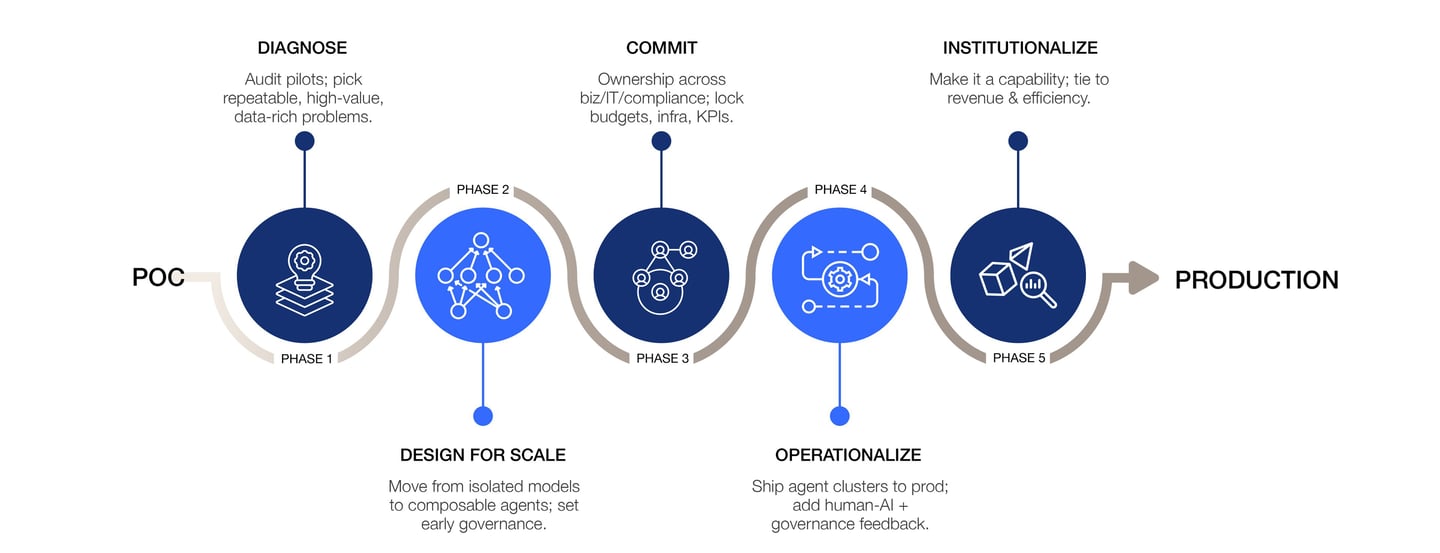
Diagnose
Audit existing pilots for ownership, ROI, and system maturity. Identify which problems are agent-worthy, meaning they are repeatable, high-value, and data-rich.
01
02
Design for Scale
Move from isolated model training to composable agent architecture. Establish governance frameworks early, including identity, observability, and compliance pipelines.
03
Commit
Secure cross-functional ownership across business, IT, and compliance teams. Establish clear commitment signals through production budgets, infrastructure readiness, and measurable success KPIs.
04
Operationalize
Deploy initial agent clusters into production-grade environments. Embed feedback loops that support continuous human-AI learning and governance validation.
05
Institutionalize
Transition from project to capability. Integrate agentic AI into the enterprise fabric, linking it directly to revenue growth and operational efficiency.
Quick Wins vs. Strategic Scale
Start where scale shows fastest returns.
Map workflows by knowledge worker complexity and transaction volume:
• Quick wins (weeks): low-complexity, high-volume tasks — claims posting, content tagging, ticket triage.
• Collaborative automations (months): high-complexity, high-volume tasks where humans and agents co-execute — e.g. procurement, campaign optimization, or compliance reporting.
This phased complexity ladder avoids burnout and builds internal belief.
From Experiments to Endurance
AI transformation is no longer about the next pilot; it’s about building enduring, learning systems that can evolve with the business.
At Avataar, we’ve seen this firsthand, whether helping a global retailer move from content automation pilots to full-fledged AI storytelling at scale, or enabling a healthcare leader to operationalize agentic workflows that cut turnaround time by 50%.
The lesson is clear:
AI doesn’t scale because of technology alone. It scales when organizations design for autonomy, governance, and human-AI synergy from day one.
Scaling AI = Scaling Enterprise Valuation
AI pilots often focus on cost savings, while AI-native transformation focuses on value creation. Enterprises that own domain-specific data, orchestrate agentic workflows, and deploy models on-prem command higher valuation multiples.
Why? Because they build defensible IP moats through proprietary datasets, task-specialized models, and long-term learning memory that compound over time. Agentic AI becomes not just an operational asset, but a driver of enterprise value.
Agentic Architecture: How Platforms Scale Beyond Pilots
The foundation of scalable AI is modularity. Agentic platforms follow a Mixture-of-Experts design, coordinating multiple specialized agents through shared memory, contextual data, and inference layers.
This architecture enables:
Seamless integration of new domain agents without retraining core models
Human-in-the-loop control where required
Continuous self-learning through feedback and reflection
Long-term memory that retains institutional knowledge and reduces retraining costs
In Avataar’s platform, this translates into modular, workflow-specialized agents powered by proprietary perception, memory, and inference layers, delivering autonomous outcomes while preserving human oversight.
Human + Agent Collaboration: The Future Operating Model
Autonomy without oversight breeds risk; oversight without autonomy limits scale. The future lies in collaborative intelligence, where agents act, humans steer, and both continuously learn.
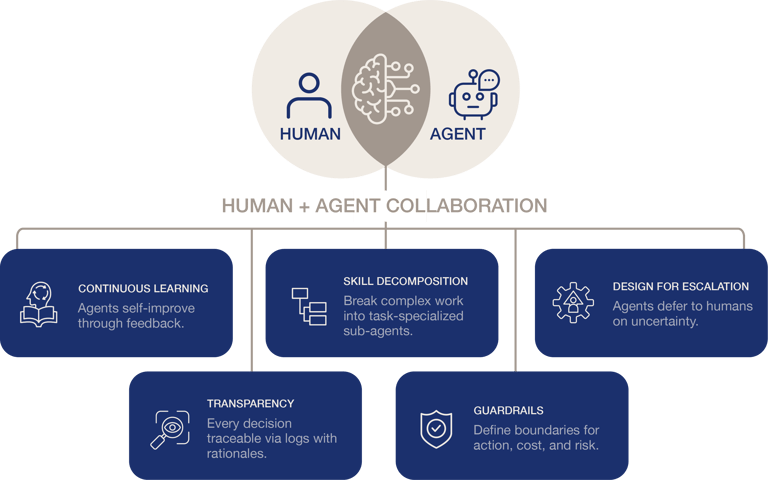
Continuous learning: agents improve through feedback and reflection.
Transparency: every decision is traceable through logs and supporting rationale.
Skill decomposition: break complex work into task-specialized sub-agents.
Guardrails: define boundaries for action, cost, and risk.
Design for escalation: agents defer to humans when uncertainty is high.
This isn’t replacing human expertise; it’s amplifying it, turning tacit knowledge into codified intelligence that compounds across workflows.
From Cost Savings to Competitive Moats
On-prem, domain-aware agentic systems deliver three key advantages:
Lower inference costs compared to generic LLM deployments
Data ownership and privacy
Continuous improvement through proprietary long-term memory
This is the new competitive edge: efficiency that learns, autonomy that compounds, and IP that differentiates.
Conclusion: Escaping Pilot Purgatory
Most AI projects don’t fail because of bad algorithms; they fail because of weak integration, unclear ownership, and inadequate governance.
To move from pilot to platform, enterprises must build for continuity by architecting for scalability, compliance, and human-aligned autonomy. The journey from POC to platform is the journey from proof to profitability, from experimentation to enduring enterprise advantage.
Agentic AI doesn’t just automate; it amplifies. It learns, governs, and compounds value, turning pilots into engines of enterprise value. That’s how enterprises move from Pilot Purgatory to Agentic AI at Scale, unlocking the next era of operating leverage and transformation.